
Have you considered that your child’s challenges with daily activities might be part of a bigger picture? You’re not the only one. When we think of childhood, we envision our kids learning to dress themselves, eat, play, and participate in class activities. However, what if your child’s abilities seem to be less functional than we’d hope?
To be perfectly honest-this isn’t a diagnosis for your child. It’s actually more like you’ve noticed a trend. It helps you see how it impacts your family day-to-day and when you might want to reach out for some support.
What Does an Occupational Therapist Do?
The term “Occupation” as it pertains to kids refers to their engagement in everyday life activities, such as playing, learning, resting and sleeping, and social participation. Occupational therapists identify what your child wants and/or needs to do, identify how their barriers impact their ability to do this, and determine which skills and their strengths can help your child achieve their goals. Pediatric OT can address movement, hand skills, sensory regulation, routines and self-regulation, and home and school participation.
Let your child feel supported.
Importance of Daily Engagement
All children are different. Therefore, even if your child appears fixated on something or having difficulty completing a task, it does not necessarily mean there is an issue. Consider: Is this expected for my child’s age? How frequently does this occur? Does this occur across environments? Is this interfering with their ability to participate or causing them discomfort?
Ask, “Can your child do parts of the routines with assistance and become more independent?” Look at the overall progress in the skills of your child and not at a single point in time.
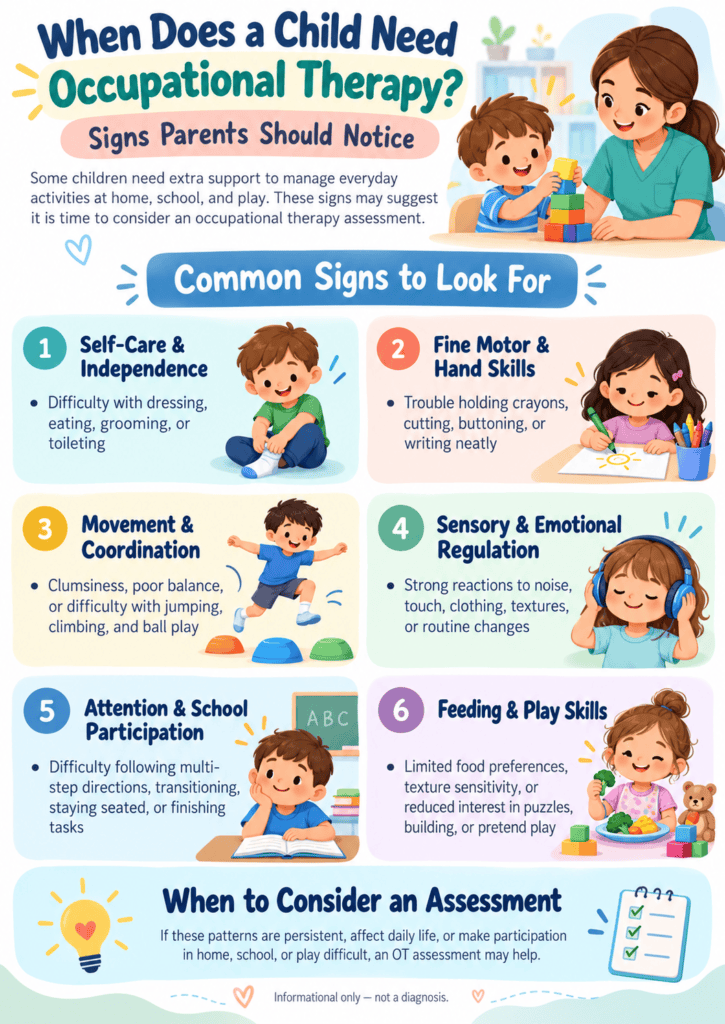
Challenges with Self-Care and Autonomy
Children develop skills of self-care over time and with practice. Some examples of a sequence of a skill: eating with a spoon, zipping a coat, brushing teeth, a toileting sequence, etc. If they are not following instructions with dressing, eating, grooming or toileting, an assessment can be very helpful.
So, what’s going on with daily routines? Maybe it’s hand control, body awareness, or motor planning. Perhaps it has to do with the sensory system, attention, or understanding the routine.
Fine-Motor and Handwriting Issues
Fine-motor skills (such as drawing, writing, cutting, building, opening containers, and grabbing small objects).
Does your child often drop small objects or have trouble holding onto crayons? Trouble with cutting out shapes or stringing beads, buttoning clothes, and getting tired easily when writing? School work that is scribbled or takes forever to write can be a real problem!
The exception: Back to the whole messy writing thing – that doesn’t necessarily mean your kid needs intervention. The therapist will consider classroom rules and expectations, as well as posture, hand strength, pencil control, and visual-motor skills.
Mobility and Coordination Issues
Balance, timing, body awareness, and motor planning are key. Things like running, climbing, jumping, and catching are needed for this. Some children may do okay with quiet play but have a hard time with movement things.
Have you observed difficulty with motor planning or dodging during game time? Do you notice clumsy or uncoordinated motor movements?
Sensory Responses and Emotional Regulation
Kids respond differently to noises, touch, movement, smells, tastes and even what they see. Perhaps your kid is not a fan of the blow dryers in the bathroom or is always on the move. Does that mean there’s an issue? Not really.
A problem becomes big when sensory challenges get in the way of participation. For example, a child is so sensitive to the feeling of clothing, water on their hair, the texture of food, or noise that they are unable to participate.
Because regulation is complicated a total child assessment must happen. Then sensory strategies specific to your child are implemented, and the “cookie cutter” approach doesn’t apply.
Attention, Organisation, and School Participation
School routines allow us to change from one thing to another, tidy up our belongings, follow instructions, show our feelings and talk to other people.
Does your child forget multi-step routines, struggle to get going, or require a lot of support in transitioning? Difficulties with focusing and fine motor skills may interfere with copying, classroom equipment, staying seated, and completing work.
Occupational therapists can analyze the relationship between task, environment, sensory processing, movement skills, and organization skills. They also can team up with parents and teachers if school functioning is an issue.
Feeding and Playing Issues
Many reasons for feeding problems Sensory and taste preferences, feeding and oral-motor skills, medical and swallowing issues, appetite, learning history, and behavior all have a part to play in what, how, and if a child will eat. If your child eats only a few foods or is very texture-sensitive, assessment is essential.
Participation in play could be affected to. Some children no longer play with construction kits, puzzles, dramatic play, or physical activities because they find it hard to move around, or they have sensory or planning problems.
If feeding has any impact on the health, growth, safety or family life of a child, it is best to see a pediatrician or a feeding specialist.
Practical Checklist: Patterns Parents May Notice
This is only a sign list. It won’t make a diagnosis or tell you when therapy is needed.
Self-care
– Requires significantly more assistance than usual with personal care (i.e., dressing, eating, grooming, or toileting).
– Struggles with using fasteners, forks/spoons, or more basic protocols.
Fine-motor activities
– No pencils, scissors, puzzles or small building sets.
– Consistently struggles with manipulating small objects.
Movement and coordination
– Falls frequently or seems unusually unsteady.
– No to climb, ball games or park play since they are difficult.
Sensory responses
– Becomes irritated by noise, touch, motion, brushing, or clothing.
– He is distressed or ignores the feelings or body sensation.
School participation
– Challenges with materials, handwriting, transitions, and multi-step classroom tasks.
– Requires constant redirection to complete task.
Play and social engagement
– Struggles to play with other children of his or her own age (not necessarily the same age as in the class) because of motor, sensory or planning difficulties.
– Stops attempts midway through the activity.
When Should Parents Consider an Assessment?
When, then, should I consider an assessment? Instead of “My child displays any of these checklist behaviors,” consider: Does my child’s behavior fit the pattern that is fairly typical, persistent, and meaningful to what is going on in our child’s life?
Some signs are more obvious: Constantly rejecting activities of daily living. Requiring significantly more help than friends and family. Becoming upset during routine tasks. Being unable to participate in school and play like other children.
