
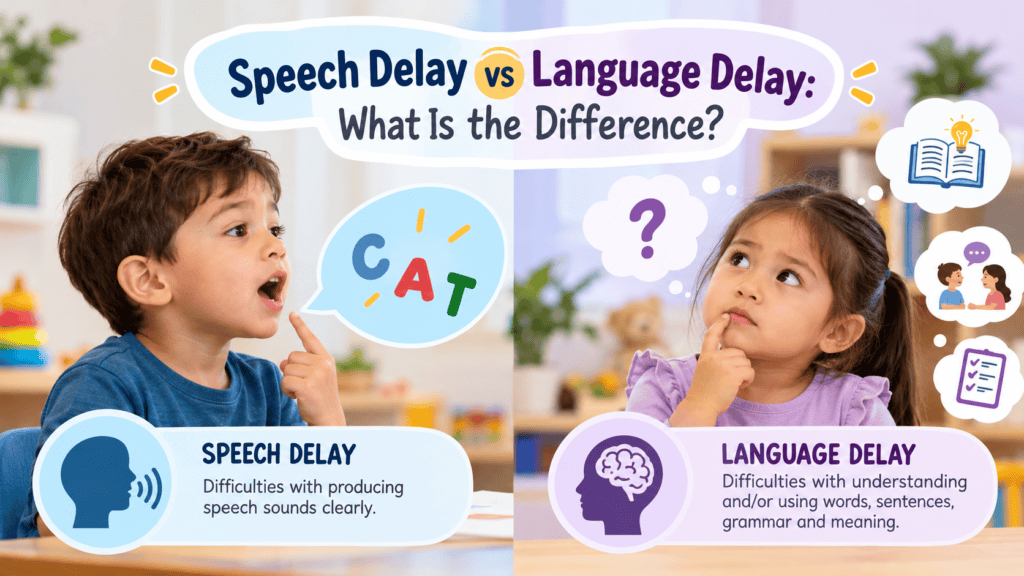
When a child has trouble communicating, parents may hear terms such as speech delay and language delay. Although they are related, they describe different areas of communication. Understanding speech delay vs language delay can help families describe what a child is finding difficult and seek suitable support.
Speech mainly concerns how sounds and words are produced. Language involves understanding and using words, sentences, grammar and meaning. A child may have difficulty in one area, both areas, or neither. Children also develop at different rates, so one sign alone does not confirm a disorder.
What Is Speech?
Speech is the physical production of spoken sounds. The lips, tongue, jaw, voice and breathing work together so that words can be understood.
A child may know exactly what they want to say but struggle to say it clearly. They may replace one sound with another, leave sounds out, repeat sounds or words, or speak with an unusual rhythm. These patterns can lead to speech clarity problems, especially when unfamiliar listeners find the child hard to understand.
What Is Language?
Language is the system we use to understand and share meaning. It includes vocabulary, grammar, sentence structure, questions, concepts and storytelling.
A child can pronounce words clearly but still have difficulty with language. For example, they may use very short sentences, struggle to explain an event, misunderstand questions or find longer directions hard to follow. Therefore, language is broader than pronunciation alone.
Understanding Speech Delay
A speech delay means speech skills are developing more slowly than expected for the child’s developmental stage. The concern may involve sound production, pronunciation, fluency, voice or overall intelligibility.
For example, a child may say “tat” instead of “cat,” leave out parts of longer words, or be difficult for unfamiliar listeners to understand. Another child may know many words but repeat sounds or struggle with smooth speech.
However, the overall pattern matters more than one isolated error. Speech sounds develop over time. A professional considers age, development, speech patterns and the effect on everyday communication.
Understanding Expressive Language Delay
Expressive language delay affects how a child uses language to share ideas. The child may understand more than they can say.
Parents may notice a limited range of words, short sentences, difficulty using grammar, or trouble explaining what happened during the day. Some children rely heavily on gestures because finding or combining words is difficult.
At school, expressive difficulties can affect answering questions, telling stories, joining discussions and explaining needs. An assessment helps identify the child’s strengths and the areas that need support.
Understanding Receptive Language Delay
Receptive language delay affects how a child understands spoken language. The child may find it difficult to understand questions, follow directions, learn new words or make sense of longer sentences.
For example, a child may follow “get your shoes” but become confused by “get your shoes, put them by the door and bring your bag.” In class, the child may appear distracted when they have actually misunderstood the instruction.
Because receptive difficulties are not always obvious, adults may mistake them for poor attention or behaviour.
Key Differences Between Speech and Language Delays
The clearest way to compare speech delay vs language delay is to ask whether the main difficulty involves producing spoken sounds or understanding and using language.
| Area | Speech Delay | Language Delay |
| Main area affected | Sounds, fluency, voice and intelligibility | Understanding and/or use of words, sentences, grammar and meaning |
| Typical signs | Sound substitutions, unclear words, repetitions | Limited vocabulary, short sentences, difficulty understanding questions or directions |
| Example behaviour | Knows the answer but says the word unclearly | Says words clearly but struggles to explain the idea |
| Effect on communication | Listeners may struggle to understand the child | The child may struggle to understand others or express thoughts |
| Professional assessment | Speech sound, fluency, voice and oral-motor assessment as appropriate | Receptive and expressive language assessment, observation and developmental history |
Can Both Occur Together?
Yes. A child may have a speech delay, a language delay, or both. For instance, a child might use only a small number of words and also pronounce those words unclearly.
When both areas are affected, communication can become more demanding. This overlap is why a full assessment may look at speech production, understanding, vocabulary, grammar, play and social communication rather than one symptom alone.
Signs Parents May Notice at Home
Parents may notice frustration when others do not understand the child, frequent use of gestures instead of words, difficulty telling a simple story, or a need for instructions to be repeated.
A child with mainly speech difficulties may use age-appropriate ideas but remain hard to understand. A child with language difficulties may pronounce words clearly yet struggle to explain needs or understand questions.
These patterns may create communication difficulties in children, but similar signs can have different causes. Hearing, development, temperament and the child’s communication environment may all play a role.
Signs Teachers May Notice at School
Teachers may notice difficulty following classroom directions, answering questions, joining conversations or explaining ideas. Group activities can also be challenging when language moves quickly.
A child with a speech difficulty may participate confidently but need to repeat themselves. A child with a language difficulty may speak clearly yet give very short answers, misunderstand instructions or struggle to retell a story.
Over time, these difficulties may affect play, early literacy, learning and friendships. Still, teachers should look for consistent patterns rather than drawing conclusions from one behaviour.
When to Consider an Assessment
Consider speaking with a pediatrician, speech-language professional or qualified developmental provider when concerns persist, affect daily participation or appear across settings. Milestones are useful guides rather than rigid deadlines, and children do not all develop at the same pace.
A hearing evaluation is also important when speech or language concerns arise because hearing problems can affect how children learn sounds and words.
Prompt professional attention is important if a child loses speech, language or social abilities they previously had.
What Happens During an Assessment?
An assessment usually starts with a discussion about the child’s development, health history and communication at home and school.
The professional may observe play and conversation, listen to speech sounds, check how well the child understands questions and directions, and assess vocabulary, sentences or storytelling. The exact process depends on the child’s age and concerns.
A hearing test or input from other professionals may also be recommended when appropriate. The goal is to understand strengths, identify needs and decide on useful next steps.
How Individualised Support Plans Are Created
After assessment, a therapist can set goals around the child’s specific needs. One child may need support with certain speech sounds, while another may need help understanding instructions, building vocabulary or forming sentences.
Plans should not look the same for every child. Support may include direct therapy, parent coaching, classroom strategies or home activities, and goals can change as the child develops.
At Blooming Buds, a child-development support centre, families can seek guidance when communication concerns continue. The focus is on understanding the child’s profile and supporting practical communication in daily life.
How Parents and Teachers Can Support Communication
Adults can support communication through everyday routines. Talk about what the child is doing, pause to give them time to respond, and expand short phrases into slightly longer sentences. If the child says “car,” for example, you might reply, “Yes, the red car is moving.”
Read together, describe pictures, sing songs and offer simple choices. Teachers can break longer instructions into smaller steps, use visual cues and check understanding.
Most importantly, respond to what the child is trying to communicate, not only how accurately they say it. Encouragement can make communication more comfortable and enjoyable.
Conclusion
Knowing the difference between speech and language delays can help parents and teachers describe concerns more clearly, but it cannot diagnose a child. Speech focuses on how spoken words are produced, while language involves understanding and expressing meaning.
If concerns continue, interfere with learning or relationships, or cause repeated frustration, professional guidance can provide clarity. Families can contact Blooming Buds to discuss their concerns and explore whether a speech and language assessment may be helpful. An individualised evaluation can identify strengths, clarify needs and guide appropriate support without assuming every child requires the same approach.
