
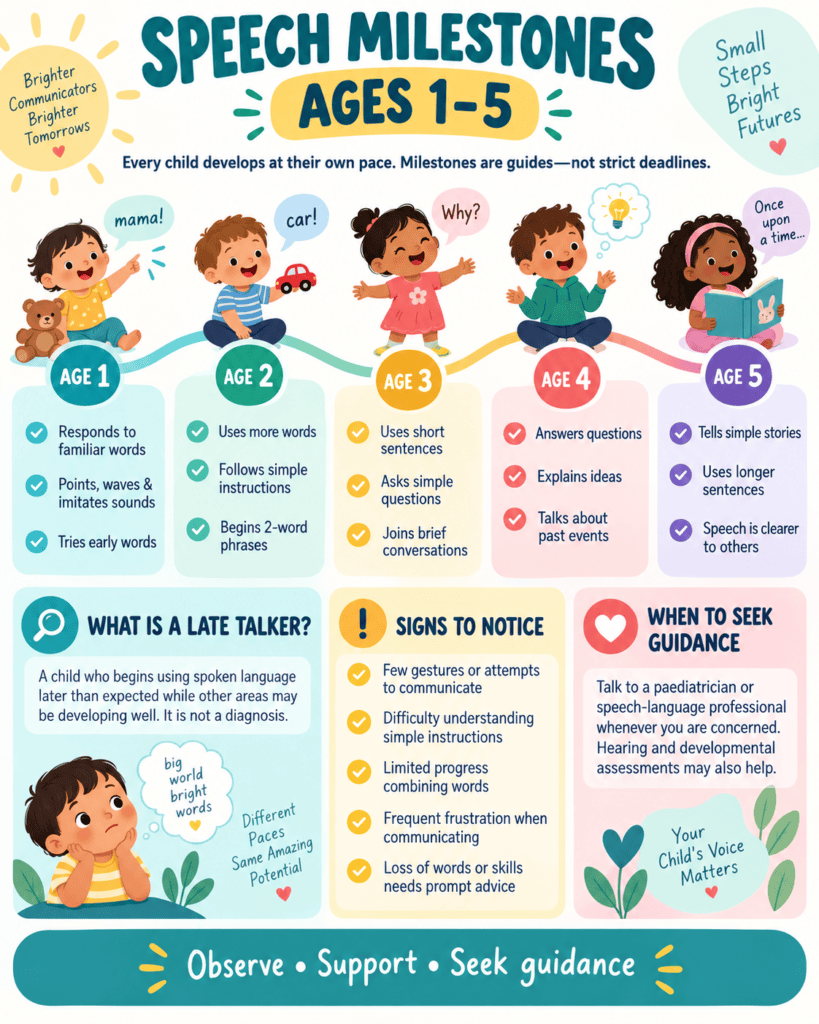
Children develop communication in different ways. Some children start speaking while other children take more time. Therefore, speech milestones should guide observation than act as strict deadlines.
Communication includes more than words. Understanding language using gestures, playing, interacting and taking turns also matters. If concerns arise, a paediatrician or speech-language professional can help parents understand a child’s development.
Language Milestones by Age
Around Age 1
By one year, many children respond to familiar words, point or wave, imitate sounds and try early words. Children may use sounds, gestures or words to communicate.
Around Age 2
During the year, children generally become more intentional communicators. Children may understand instructions, use more words and begin combining two words, such as “more milk” or “go outside.” However, pronunciation may still be unclear.
Around Age 3
By three years, many children use short sentences, ask simple questions, describe activities and join brief conversations.
Around Ages 4 and 5
Between four and five years, children typically use sentences to answer questions, explain ideas, talk about past events and tell simple stories. Children’s speech also becomes easier for unfamiliar listeners to understand.
What Does “Late Talker” Mean?
A late talker is generally a child who begins using spoken language later than expected while other areas of development may be progressing appropriately.
Importantly, being a late talker is not a diagnosis. Some children catch up while others may need support. Professionals consider understanding, gestures, play, social interaction, communication needs and progress over time.
If you are concerned about a toddler not talking, discussing your concerns with a professional can provide guidance.
Speech Delay Signs to Notice
Parents may seek guidance if a child:
- Rarely uses gestures such as pointing or waving
- Struggles to understand familiar words or simple instructions
- Makes few attempts to communicate
- Has difficulty combining words
- Shows little progress in speech or language
- Becomes frustrated when trying to communicate
- Remains difficult for others to understand
Importantly, seek prompt advice if a child loses words, gestures, understanding or other communication skills that the child previously acquired.
These signs do not automatically indicate a condition; an assessment may help.
Speech and Language Are Different
Speech describes how a child produces sounds and says words. Language involves understanding and using words, sentences and ideas.
A child may understand language well. Struggle to produce sounds or speak clearly but have difficulty building sentences.
A speech therapist in ernakulam can consider these areas of focusing only on vocabulary.
Why Hearing and Developmental Assessment Matter
Hearing plays an important role in speech and language development. A child may respond to some sounds while still having a hearing difficulty that affects communication. Therefore, a professional may recommend a hearing assessment when concerns arise.
A paediatrician may also consider play, learning, movement, social interaction and general development.
For families considering speech therapy in kochi an individual assessment can help identify whether support may be appropriate.
When Should Parents Seek Support?
Parents can speak with an qualified professional whenever they have concerns. Early guidance can help families understand whether a late talking child is developing at their own pace or may benefit from support.
A speech therapist in ernakulam may assess understanding, gestures, vocabulary, sentence development, speech clarity, play and social communication. The findings can guide support.
When appropriate speech therapy in kochi may support language understanding, vocabulary, sentence building, speech clarity or conversation skills.
Support Communication Without Pressure
Parents can encourage communication by talking during activities following child’s interests sharing books allowing time to respond and celebrating attempts.
Remember, seeking guidance does not mean something is definitely wrong. It simply helps families understand development and decide what support may be useful.
If you have concerns a speech therapist in ernakulam can help you understand your child’s strengths and needs. Families exploring speech therapy in kochi can seek guidance based on an assessment.
